
Spring Showers Bring …. Data Centers???
Why has Oregon — and particularly the area west of Portland — become such fertile ground for massive data infrastructure? And why do I keep riding past what increasingly looks like one of the quiet hubs of the global internet? And the rule of 15-15-15
John Spiegel
3/13/20265 min read
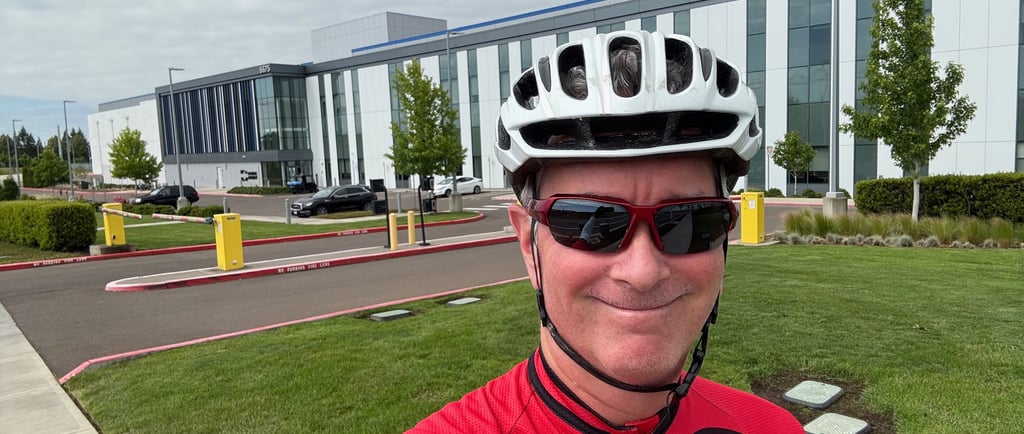

The weather is finally improving here in Oregon for cycling. Despite this week’s “Pineapple Express” (and no, not that’s now the name of an amazing slice of pizza), I’ve started getting back into my usual rhythm of 1–2 hour rides west of Portland.
If you ride out that direction often enough, you start to notice something interesting.
Spring in Oregon is when flowers burst out of the ground and everything turns green again. But west of Portland, another kind of bloom has been happening over the past decade — and especially the past few years.
Data centers.
They seem to be going up everywhere.
Not the small enterprise ones either. The buildings shooting out of the ground around Hillsboro and across Washington County are massive — warehouse-sized facilities with enormous power infrastructure, fenced perimeters, and cooling systems that quietly hum day and night.
And they keep getting bigger.
As I ride through the area, I often pass by one particular hub of activity tied, I know various data centers are hubs for LinkedIn and X, and suspect the newest creations are tied to companies like Google, Amazon Web Services, and Meta scattered throughout the region.
It raises an obvious question:
Why here?
Why has Oregon — and particularly the area west of Portland — become such fertile ground for massive data infrastructure?
And why do I keep riding past what increasingly looks like one of the quiet hubs of the global internet?
Let’s explore that.
The AI Boom Needs Physical Infrastructure
The recent explosion of artificial intelligence has created something many people don’t immediately think about: a massive demand for physical infrastructure.
Training and running modern AI models requires enormous computing clusters made up of thousands of GPUs running continuously. Those clusters live in data centers — buildings specifically designed to deliver power, cooling, and network connectivity at enormous scale.
A decade ago, data centers were already growing due to cloud computing. But AI has accelerated that growth dramatically.
Traditional enterprise servers might consume:
5–10 kilowatts per rack
Modern AI racks can consume:
80–150 kilowatts per rack
That’s a completely different category of infrastructure.
Entire campuses now require 100–500 megawatts of power, roughly equivalent to the electricity consumption of a small city.
Why Oregon Works So Well
For companies building these facilities, a few factors matter more than anything else:
Cheap and reliable electricity
Cool climate
Network connectivity
Tax advantages
Available land
Oregon happens to check nearly all of those boxes.
1. Power from the Columbia River
Much of the region’s electricity comes from hydroelectric power generated along the Columbia River.
Hydroelectric energy provides:
relatively low-cost power
renewable energy sources
stable long-term pricing
For companies running tens or hundreds of megawatts of computing infrastructure, electricity costs are one of the biggest operating expenses.
Even small differences in power prices can change the economics of a project by hundreds of millions of dollars over time.
2. Oregon’s Climate Helps Cooling
Anyone who lives here knows the weather can be… damp.
But that’s actually useful for data centers.
Cooling servers is expensive. In warmer climates, operators must run large mechanical cooling systems year-round. Oregon’s relatively mild temperatures allow many facilities to use outside air cooling for much of the year, dramatically lowering operating costs.
3. Direct Fiber Routes to Asia
One factor that often gets overlooked is Oregon’s position in the global internet’s physical network.
Submarine fiber optic cables connect North America to Asia across the Pacific, and many of those cables land along the Pacific Northwest coast before running inland through Oregon and Washington.
From there, fiber routes connect directly into the data center corridors west of Portland.
This creates extremely efficient network paths between North American cloud infrastructure and major Asian markets like Japan, South Korea, and Singapore.
For global cloud providers and AI companies, that connectivity matters enormously. Lower network latency and diverse fiber routes improve reliability and performance for international services.
In many ways, the fiber infrastructure running through Oregon forms part of the digital backbone between North America and Asia.
4. No Sales Tax
One of Oregon’s most underrated advantages is its lack of a state sales tax.
This matters a lot when a company is purchasing billions of dollars of servers, networking equipment, power systems, and cooling infrastructure.
Avoiding a sales tax of 7–10% on that equipment can reduce project costs by hundreds of millions of dollars.
5. Tax Incentives for Large Projects
Oregon also offers programs like enterprise zones and other incentives designed to attract major infrastructure investment.
These programs often reduce property taxes for large facilities during their early years, making the economics even more attractive.
The “15-15-15” Rule of Data Center Economics
Within the infrastructure investment world, a shorthand has started to circulate that captures just how attractive data centers have become.
It’s sometimes referred to as the “15-15-15 rule.”
The idea is simple:
15-year leases
15% development yields
$15 per watt of value creation
Let’s break that down.
Long-Term Leases
Companies like Microsoft, Amazon Web Services, and Google often sign extremely long leases for data center capacity — sometimes 10–20 years.
These leases are typically structured as “take-or-pay” agreements, meaning the customer pays for the capacity whether they use it or not.
For investors, that creates extremely predictable revenue streams.
Strong Development Returns
A typical large-scale data center might cost $8–12 million per megawatt of power capacity to build.
Once fully leased and operational, the facility may generate returns equivalent to 12–18% yields.
In the world of infrastructure and real estate, that’s a remarkably attractive return profile.
Value per Watt
The final part of the equation involves the value created by building power capacity.
In simple terms:
Construction costs might run around $8–10 per watt
Stabilized asset values can reach $20–25 per watt
That difference — often around $15 per watt — represents the value created by building and leasing the facility.
For a 100-megawatt campus, that can translate into over a billion dollars of value creation.
How Oregon Fits Into That Model
Oregon actually amplifies parts of this equation.
Lower electricity costs, no sales tax on equipment, a cool climate, and strong international fiber connectivity all reduce both operating costs and construction costs while increasing the strategic importance of the region.
In many cases, projects here may even outperform the typical 15-15-15 framework because the cost basis starts lower and the connectivity advantages are strong.
But there’s one emerging constraint.
Power itself.
The biggest challenge for new facilities today isn’t buildings or servers — it’s gaining access to enough electricity and grid infrastructure to support these enormous computing clusters.
Riding Through the Physical Internet
When you ride through the quiet industrial areas west of Portland, it doesn’t always feel like you’re passing through something globally significant.
From the outside, most data centers just look like large gray buildings surrounded by substations and cooling towers.
But inside those walls live the machines that power much of the modern internet — cloud platforms, streaming services, AI models, and countless digital tools people rely on every day.
And increasingly, those machines are also connected directly to global fiber routes spanning the Pacific.
So the next time I’m out on one of those rides between rain showers and patches of sun, pedaling past another massive new building under construction, I’ll probably think of it the same way I think about spring flowers.
Just another sign of what’s growing here in Oregon.